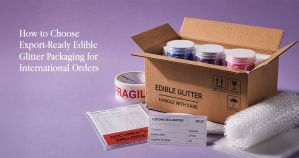
If you run a bakery, cake shop or food import business outside the UK and you are placing your first order with a British supplier, you may have come across the term ‘Export Health Certificate’ somewhere in the paperwork conversation. It sounds official, a bit daunting, and not entirely clear what it actually covers.
This guide explains what an export health certificate UK food supplier relationship typically involves, when one is actually needed, and what international buyers should expect when ordering edible glitter and similar decoration products from the UK. We will keep things simple, because the honest answer for most edible glitter orders is more reassuring than you might think.
What Is an Export Health Certificate and Why Does It Exist
An Export Health Certificate, usually shortened to EHC, is an official document that confirms a food product meets the health and safety requirements of the country it is being shipped to. Think of it as a formal statement, signed by an authorised certifying officer, that says ‘this product was made under proper hygiene conditions and is safe to enter your country’.
EHCs exist mainly to protect public health and animal health across borders. These certificates confirm that a specific business complies with all relevant legislation and that the food produced is without health risk. They give the importing country’s authorities confidence that the exporting business is registered, inspected and operating to recognised standards.
Historically, EHCs were created with products of animal origin in mind. Fresh meat, dairy, fish and similar items have long needed this kind of certification when crossing borders, partly because of disease control concerns that have nothing to do with food hygiene in the everyday sense, and partly because of the risk these products carry if mishandled.
For a small business in Nuneaton, Warwickshire, making prismatic edible glitter from maltodextrin, this might sound like it belongs to a different world entirely. And in many respects, it does. But it is worth understanding the framework, because it shapes what documentation you will and will not be asked for when you place an international order.
If you are curious about the bigger picture of does Magic Sparkles ship edible glitter wholesale internationally, that guide covers the wider logistics of ordering from the UK as an overseas buyer.
Does Edible Glitter Require an Export Health Certificate
Here is the part that tends to bring a sigh of relief. Edible glitter, being a product of non-animal origin made primarily from maltodextrin and plant-based colourings, generally falls outside the scope of a formal APHA-issued EHC.
The products of non-animal origin do not generally require a formal EHC, but the country receiving the products may require some form of proof to confirm compliance with food law. In plain terms, edible glitter is not the kind of product the EHC system was originally built around. There is no meat, dairy, egg or fish content involved, so the formal veterinary certification chain that governs products of animal origin simply does not apply in the same way.
That said, ‘generally not required’ is not the same as ‘never required’. Some destination countries, particularly those with stricter import controls or less familiarity with edible decoration products, may still ask for some form of compliance documentation. This is where things can get a little confusing for first-time international buyers, because the terminology often gets used loosely.
A useful comparison: imagine ordering a batch of artisan jam from a small UK producer for your cafe in another country. The jam itself, being plant-based, would not typically need a formal EHC either. But your customs authority might still want to see proof that the producer is registered, inspected and operating to food safety standards. That is the kind of documentation that often comes into play for products like edible glitter, too.
For background on the certifications that already sit behind every Magic Sparkles product, including halal and kosher certified glitter for commercial bakeries, it helps to see how these existing trust signals can support an export conversation even when a formal EHC is not the right document.
APHA vs Local Authority: Who Issues Certificates for Processed Foods
To understand who does what, it helps to separate the two main bodies involved in UK food export certification.
APHA, the Animal and Plant Health Agency, handles certificates for products of animal origin: in Great Britain, APHA is responsible for issuing export health certificates for certain products of animal origin to specific countries. This covers fresh meat, dairy, fishery products, eggs and similar items where formal veterinary sign-off is the norm.
Local authorities step in for products that fall outside the APHA remit: local authorities can provide export certification for certain products not covered by official EHCs issued by APHA. For a product like edible glitter, a local authority in the area where the manufacturer is based and registered would typically be the relevant body, should any certification be needed at all.
Local authority certifying officers can sometimes act on APHA’s behalf too: in Great Britain, Local Authority Food Competent Certifying Officers are authorised by APHA to sign certain APHA-issued EHCs. This dual role can make the system feel a little tangled from the outside, but the short version is that for processed, plant-based products, the local council covering the manufacturer’s registered premises is usually the first port of call.
It is also worth knowing about the Certificate of Free Sale, a related but different document: you may also need a certificate of free sale if you’re exporting processed food or drink, and the food authority in the country you’re exporting to will tell you if you need one. This certificate confirms that a product is legally sold and consumed in the country of manufacture, which can sometimes satisfy an importing country’s requirements even where a formal EHC does not exist for that product category.
For UK manufacturers, the responsibility ultimately sits with the exporter. It is the responsibility of the exporting business to find out what the import requirements are in the destination country. A supplier who takes this seriously will already have done this homework long before your order ships.
The EHC Application Process Step by Step
For products that do fall within the EHC system, the process tends to follow a fairly consistent pattern, even though the specific certificate template varies by product and destination.
Identify the correct certificate template for the product and country combination: if an agreement exists with the country you are exporting to, there is likely to be an export health certificate template online, and once you have found the relevant certificate, you must apply for it online. This step is where many exporters first discover whether their product category even has a relevant template, which, for non-animal origin goods, is often the moment they realise a formal EHC is not the right fit.
Confirm which type of certifying officer is authorised to sign: each importing country specifies what kind of certifying officer can sign an EHC for a particular product or range of products, and this requirement is specified on the certificate and in the accompanying Notes for Guidance. This matters because not every council officer or vet is automatically eligible to sign every certificate type.
Submit the application along with supporting information about the consignment: the application will ask for details about the product, the business, and the shipment itself, which leads us neatly into the next section.
Allow for an inspection or assurance check if required: the certifying body will not supply a certificate unless the food business is registered, and they can assure the safety of the individual batch or consignment, and they may need to inspect the business to verify the food is produced in compliance with UK legislation.
Receive the signed certificate ahead of shipment: the certificate then travels with the consignment or is sent digitally to the buyer, depending on the destination country’s customs process.
For edible glitter specifically, most of this process simply does not apply in its full form. But a reputable supplier should be able to walk you through whichever step of this chain, if any, applies to your particular order and country.
Documents and Information Required Before You Apply
Whether a formal EHC, a Certificate of Free Sale, or a simpler compliance letter is needed, the underlying information requested tends to be similar.
Typical information required for an export health certificate includes the manufacturer, consignor, consignee, destination, product, quantity, country of origin, description and batch number where appropriate. A well-organised supplier should be able to produce all of this without delay, because it is simply a record of what is being sent, by whom, to whom, and in what quantity.
Beyond the certificate-specific information, international buyers commonly also want to see:
Proof of food business registration: a confirmation that the manufacturer is registered with their local council as a food business, which is a basic legal requirement for any UK food producer
Certificates of analysis or compliance: documentation that the product meets relevant UK and, where applicable, EU food safety standards, including allergen and ingredient information
Existing third-party certifications: documents such as vegan, halal, kosher or SALSA approval, which many overseas buyers find genuinely useful even when they are not formally part of an export certificate, because they speak to the same underlying standards of traceability and hygiene
A clear ingredients and allergen declaration: particularly important for edible glitter, where buyers want to confirm the absence of certain additives or allergens for their own local labelling requirements
If your business already touches on clean label or additive-free positioning, our piece on E171 compliance and clean-label certification explains how ingredient transparency fits into the wider compliance picture, which is often exactly what international buyers are really asking about when they mention ‘health certificates’.
How Long Does an Export Health Certificate Take to Process
Timelines vary depending on the certifying body, the product, and how complete the application is when it is submitted.
Dependent on the nature of the consignment and payment processes, certifying bodies typically need three to five working days to process and issue an EHC.
For products requiring fuller assessment, the picture can take longer. Budget planning advice from export specialists suggests factoring in seven to ten working days for the overall process, particularly where inspections are involved.
The good news for edible glitter buyers is that, because most orders do not require a formal EHC at all, the documentation that does travel with the shipment, such as ingredient declarations, compliance letters and existing certifications, can usually be prepared well ahead of dispatch rather than holding up the order at the last minute. A supplier who keeps this paperwork organised as standard practice, rather than scrambling per order, is generally a sign of a business that takes export seriously.
Country-Specific EHC Requirements International Buyers Should Know
One of the trickiest parts of food export documentation in UK international trade is that requirements are not uniform. What satisfies customs in one country may not be enough for another, even for the exact same product.
Individual countries have specific requirements in terms of the types of documentation needed for products being exported, and the requirements differ depending on the country and the specific type of product. There is, frustratingly, no single master list that covers every product and every destination.
This is why it is the responsibility of the exporting business to find out what the import requirements are in the destination country rather than assuming a one-size-fits-all certificate will do the job everywhere.
For buyers in the European Union, requirements may differ from those for buyers in the EU. Following the UK’s departure from the European Union, export health certificates now follow either the Great Britain model for destinations within England, Scotland or Wales, or the EU model where shipments are routed via Northern Ireland. While this detail is mainly relevant to product categories that do need formal EHCs, it illustrates how the post-Brexit landscape has added layers of complexity that simply did not exist a few years ago.
For buyers in the US, Australia, or further afield, the safest approach is always the same. Ask your supplier directly which documents they typically prepare for shipments to your country, and check with your own customs broker or import agent about what your local authority expects on arrival. A good UK supplier will not be surprised by this question. They will likely have answered it many times before for buyers in similar regions.
What Happens If Your Shipment Is Rejected at Customs Without Correct Certification
This is the scenario every international buyer wants to avoid, and understandably so. A shipment held at customs means delayed stock, frustrated staff, and in the worst cases, products that have to be returned or destroyed at the buyer’s expense.
The reasons a food shipment gets flagged at customs are rarely about the product itself being unsafe. More often, it comes down to a documentation mismatch. Perhaps the importing country’s customs system expected to see a Certificate of Free Sale, but none was provided. Perhaps the ingredient declaration did not match what was on the product label. Perhaps the manufacturer’s registration details were missing from the paperwork that travelled with the consignment.
Foods found at a business that have been illegally imported may be seized and destroyed by officers, and while this rule is aimed at the receiving end of imports into the UK, it illustrates the kind of outcome that customs authorities everywhere can apply when documentation does not stack up.
For a business owner who has placed a wholesale order, perhaps for a busy wedding season or a seasonal stock-up, this kind of delay can be genuinely costly. It is one of the quieter reasons why working with a supplier who proactively prepares the right paperwork, rather than waiting to be asked, makes such a practical difference.
How Magic Sparkles Prepares Export Documentation for International Orders
Magic Sparkles is manufactured in a SALSA-approved facility in Nuneaton, Warwickshire, the kind of small-batch, traceable production that underpins much of what international buyers are really looking for when they ask about export certificates.
Because edible glitter generally sits outside the formal EHC system, our approach focuses on the documentation that genuinely matters for your shipment and your local customs process. That includes clear ingredient and allergen declarations, confirmation of our vegan, halal and kosher certifications, and food business registration details, all prepared and ready to travel with your order.
Where a buyer’s country does require something more specific, such as a Certificate of Free Sale or a local authority compliance letter, we work with our certifying body to put this together ahead of dispatch. We would rather have the conversation with you early, well before your order is due to ship, than leave it until a container is sitting at a port somewhere.
If you are placing your first wholesale order and want to understand what paperwork will travel with your shipment, do contact us to start your international order. You can also browse Magic Sparkles wholesale edible glitter to see the full range available for export.
Conclusion
For most international buyers, the words ‘Export Health Certificate’ sound far more intimidating than the reality turns out to be, at least where edible glitter is concerned. Because the product is plant-based and falls outside the categories that formal EHCs were designed around, the documentation that actually matters tends to be more straightforward: ingredient declarations, existing certifications, and proof of registration with a UK food authority.
The real value, for any buyer, lies in working with a supplier who understands this landscape well enough to prepare the right paperwork without being asked twice. That is the quiet, unglamorous side of international trade that makes the difference between a smooth delivery and a shipment stuck at a port somewhere, and it is something worth asking about before you place your first order.
FAQs
Does edible glitter from the UK need an Export Health Certificate to be imported?
Generally, no. Edible glitter is a product of non-animal origin, and products of non-animal origin do not generally require a formal Export Health Certificate, though the receiving country may ask for some form of proof of compliance with food law. Most buyers will instead be looking for ingredient declarations and existing certifications.
Who issues Export Health Certificates for processed food products in the UK?
Local authorities can provide export certification for products not covered by official EHCs issued by APHA, while APHA itself is responsible for issuing EHCs for certain products of animal origin to specific countries. For a processed, plant-based product, the local council where the manufacturer is registered is usually the relevant body, where any certification is needed at all.
How long does it take to get an Export Health Certificate for a food export?
Certifying bodies typically need three to five working days to process and issue an EHC, though it is sensible to budget for seven to ten working days overall, particularly where inspections are involved.
What documents should an international buyer request alongside an EHC?
Buyers should ask for proof of food business registration, ingredient and allergen declarations, and any relevant third-party certifications such as vegan, halal, kosher or SALSA approval. Standard information such as manufacturer, consignor, consignee, destination, product, quantity, country of origin and batch number should also be readily available.
Is an Export Health Certificate the same as a Certificate of Free Sale?
No, they are different documents serving different purposes. A Certificate of Free Sale may be needed for exporting processed food or drink, and the food authority in the destination country will confirm if one is required, whereas a formal EHC is more closely tied to products of animal origin and veterinary-style certification.