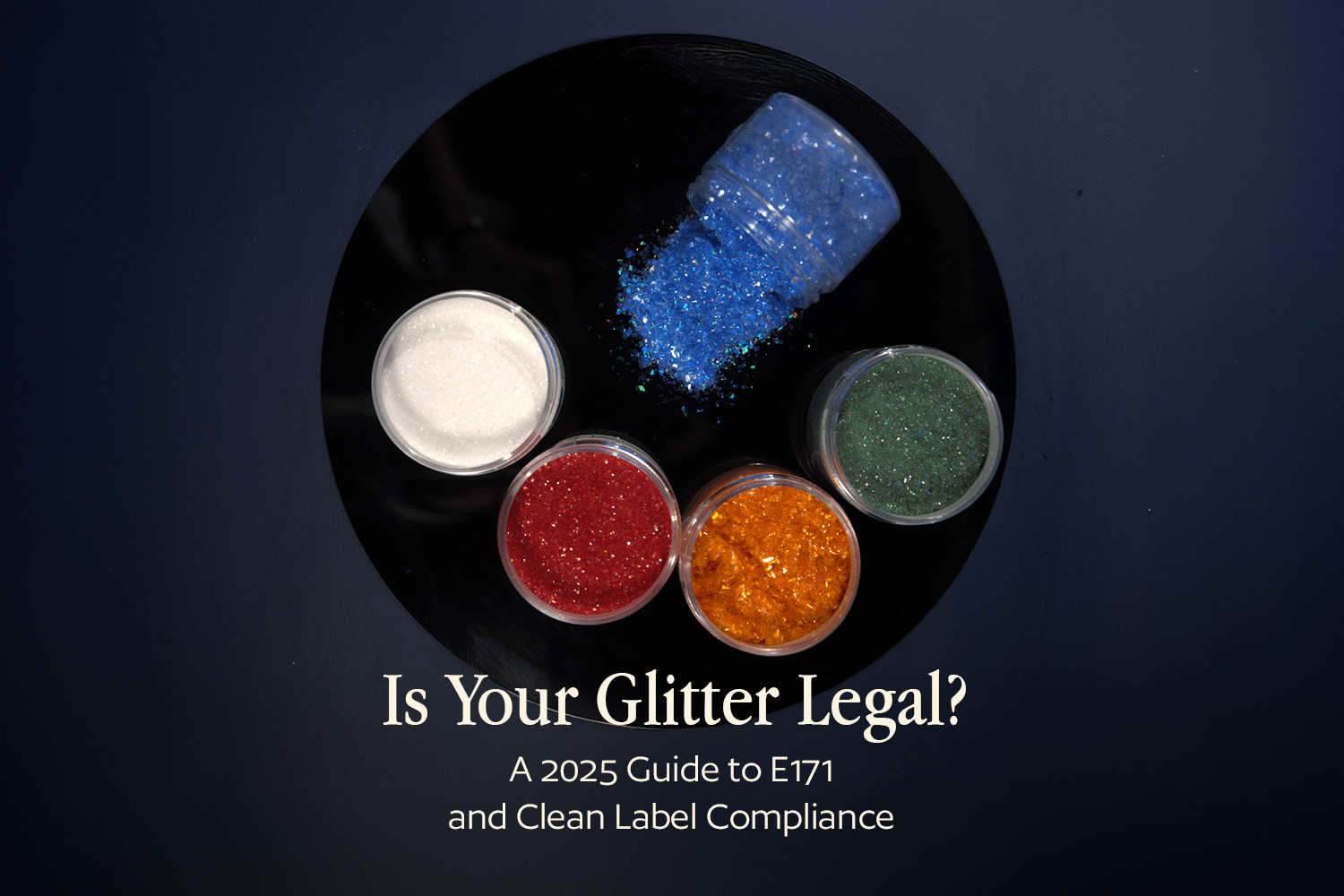
If you’ve been using the same edible glitter for years without checking ingredient labels lately, you might be using products that are no longer compliant with current regulations.
The 2022 ban on titanium dioxide across the EU sent shockwaves through the baking industry, and the ripple effects continue into 2025.
Understanding titanium dioxide in edible glitter, why it was banned, and what this means for your baking business isn’t just about compliance, it’s about protecting your customers and your reputation.
Let’s break down what you need to know about E171 additive regulations and how to ensure your sparkle stays legal and safe.
What titanium dioxide is and why it’s used in food
Titanium dioxide, also known as E171 additive, is a white pigment used to create opacity and brightness in everything from paint to food products.
In food applications, this additive serves multiple purposes. It creates vivid white color, enhances brightness in other colors, and provides opacity that makes decorations stand out visually.
For decades, it appeared in candies, cake decorations, chewing gum, and thousands of processed foods.
Manufacturers loved titanium dioxide because it’s cheap, stable, and effective. Unlike natural white colorants that might be translucent or off-white, E171 delivered pure, brilliant white and helped other colors pop.
The food industry used titanium dioxide in both bulk form and nano-particle form. These microscopic particles could penetrate products more evenly, creating consistent color throughout.
This seemed like a technological advancement until scientists started asking questions about what happens when we consume nano-particles regularly?
Understanding E171 and its role in edible glitter
E171 additive is the European designation for titanium dioxide when used in food. The “E number” system identifies food additives approved for use in the EU.
For years, E171 carried regulatory approval and was considered safe. Regulatory bodies like the FDA in the US and EFSA (European Food Safety Authority) in Europe approved it for food use based on available research.
Edible glitter manufacturers relied heavily on this white pigment because it provided several advantages. It created a brilliant white shimmer that plant-based alternatives couldn’t match.
It remained stable under various conditions: heat, light, and moisture without degrading. And it was significantly cheaper than natural alternatives.
Many popular brands built their entire product lines around E171 additive formulations. The white, silver, and pearl finishes customers loved depended on these properties.
But behind the scenes, scientific research was raising concerns about edible glitter safety that would eventually change everything.
Why titanium dioxide was banned in the EU
In May 2021, the European Food Safety Authority (EFSA) issued an opinion that would reshape the edible glitter industry. After reviewing available scientific evidence, EFSA concluded they could no longer consider E171 safe for consumption.
The concern focused on genotoxicity, the possibility of DNA damage. The additive couldn’t be proven safe, especially due to nano-particles that may accumulate in body tissues.
EFSA’s position was clear: when you can’t exclude the possibility of genotoxic effects, you can’t approve a substance for food use. This precautionary approach prioritized consumer safety over industry convenience.
Following this scientific opinion, the European Commission acted quickly. In January 2022, they officially banned the E171 additive and all food products across EU member states.
The titanium dioxide ban gave manufacturers a six-month transition period, with the prohibition taking full effect in August 2022.
This wasn’t just about edible glitter safety, it affected thousands of products. Ice cream, salad dressings, supplements, candies, and baked goods all needed reformulation to comply with EU food rules.
The ban specifically targeted food use. Titanium dioxide remains legal in pharmaceuticals, cosmetics, and non-food applications. But if something goes in your mouth as food, the E171 additive is now prohibited throughout the European Union.
Is edible glitter still legal in the UK
Brexit created regulatory divergence between the UK and EU, but when it comes to edible glitter regulations, the situation remains complex in 2025.
Technically, the UK could choose different standards than the EU. However, the Food Standards Agency (FSA) has been reviewing the same scientific evidence that led to the edible glitter ban.
As of 2025, E171 remains legal in the UK, but the writing is on the wall. The FSA has indicated they’re likely to follow EU food rules on this issue. Many food safety experts expect UK regulations to align with the titanium dioxide ban within the next year or two.
For professional bakers and food manufacturers, this creates a strategic decision point. You can continue using products containing the controversial additive while it’s still legal, or you can proactively transition to clean label baking alternatives now.
Smart operators are choosing the latter. Here’s why:
Market access: If you export to EU countries or supply retailers with EU operations, you already need titanium dioxide-free products. Getting ahead of UK regulations future-proofs your business.
Consumer perception: Savvy consumers read labels and research ingredients. Even while legal, E171-containing products carry reputational risk when customers learn about the EU ban.
Supply chain preparation: Manufacturers are already reformulating. Waiting until the UK ban is official might leave you scrambling for alternatives during a supply crunch.
Magic Sparkles never used titanium dioxide, even before the ban. Our founder, Harish Patel, built our formulations around maltodextrin and natural plant-based colorants from day one, no E171 additive, no reformulation stress, no compliance concerns.
The difference between edible and non-toxic cake glitter
Understanding edible vs non toxic glitter becomes crucial when navigating regulations and edible glitter safety.
Truly edible glitter is made from food ingredients like maltodextrin, sugar, or starch. Your body digests it and metabolizes it like any other food. When we talk about the edible glitter ban, we’re discussing products that are genuinely meant to be eaten.
Non-toxic glitter is made from plastic, typically polyester (PET). It’s labeled “non-toxic” because it passes through your digestive system without poisoning you, but it doesn’t break down or provide nutrition. It’s not food, it’s inert material.
Here’s where confusion arises: some products marketed as “edible” are actually non-toxic plastic glitters. They might say “edible” on the front label but fine print reveals “for decoration only” or “remove before consuming.”
The titanium dioxide ban only applies to actual food products. Plastic craft glitters aren’t covered by EU food rules because they’re not food though they probably shouldn’t be on cakes anyway.
When evaluating edible glitter safety, ask these questions:
- Is it made from food ingredients or plastic?
- Does it dissolve in your mouth or remain intact?
- Would you call it an ingredient or a decoration?
True food grade glitter uses ingredients like maltodextrin, gum arabic, natural colorants, things you’d recognize as food. Products relying on E171 fell into this truly edible category, which is why the ban affected them.
Clean label compliance for bakers and food brands
The titanium dioxide ban accelerated a trend that was already reshaping food manufacturing: clean label baking.
Clean label refers to products with short, recognizable ingredient lists. Consumers increasingly demand transparency, they want to know exactly what they’re eating and feeding their families.
For bakers pursuing clean label baking compliance, eliminating the controversial additive is just one step. The broader movement means choosing natural edible glitter made from plant-based ingredients without synthetic additives.
Clean label principles:
Short ingredient lists: Five to ten recognizable ingredients instead of twenty unpronounceable chemicals.
Natural sources: Plant-based colorants from spirulina, beetroot, turmeric instead of synthetic FD&C dyes or the E171 additive.
Minimal processing: Ingredients that look similar to their original form rather than highly processed chemical compounds.
Transparent sourcing: Knowing where ingredients come from and how they’re produced.
The edible glitter safety conversation fits perfectly into clean label baking. Products containing banned substances fail clean label standards even where they are still legal because consumers perceive them as questionable.
Magic Sparkles products represent clean label compliance. Our ingredient lists are short: pharmaceutical-grade maltodextrin, natural plant extracts, and modified starch. No E171 additive, no synthetic colors, no ingredients your grandmother wouldn’t recognize.
For commercial bakeries, clean label baking isn’t just feel-good marketing, it’s a competitive advantage. Customers actively seek products meeting these standards, and premium pricing often follows.
How to check ingredient labels on edible glitter
Protecting yourself from non-compliant or questionable products requires knowing how to read labels on safe cake supplies.
Look for these red flags indicating E171:
- “Titanium dioxide” listed in ingredients
- “E171” in the ingredient list
- “Color added” without specifying which colors
- “Mineral-based white pigment”
If you’re shopping in the UK where it’s still legal, manufacturers must list the additive if present. However, some imported products from regions with looser labeling laws might not be transparent.
Positive indicators of safe, compliant products:
“E171-Free” or “Titanium Dioxide Free” prominently displayed. Manufacturers who reformulated want you to know, so they label clearly.
Natural colorants listed specifically: “Colored with spirulina extract, beetroot powder, turmeric” tells you exactly what creates the shimmer.
Maltodextrin or sugar base: True food grade glitter starts with these digestible carbohydrates, not minerals or plastics.
Clean label or natural claims: While not regulated terms, they signal manufacturer intent toward transparency.
Certification symbols: Vegan, Halal, Kosher certifications indicate thorough ingredient review by third parties.
For professional use, don’t rely solely on front-label marketing. Flip containers over and read actual ingredient declarations. If a manufacturer won’t provide complete ingredient information, that’s reason enough to choose different safe cake supplies.
When evaluating edible vs non-toxic glitter, the ingredient list tells you everything. Food-based ingredients mean truly edible. Polyester, PET, or plastic means non-toxic decoration, not food.
Safe and compliant alternatives to traditional glitter
The good news? Beautiful natural edible glitter alternatives exist that comply with the titanium dioxide ban and exceed edible glitter safety standards.
Maltodextrin-based glitter like Magic Sparkles creates prismatic shimmer through its natural crystal structure, not chemical additives. The light refraction delivers a jewel-like brilliance that outshines the flat look of E171-based glitters.
Plant-based colorants deliver gorgeous hues:
- Spirulina creates blues and blue-greens
- Beetroot provides pinks and reds
- Turmeric offers yellows and golds
- Purple sweet potato gives purples
These natural edible glitter options meet EU food rules, align with clean label baking trends, and appeal to health-conscious consumers.
Sugar-based alternatives work well for certain applications, though they dissolve faster than maltodextrin varieties.
Mica-based luster dusts (when properly certified as food-grade glitter) create metallic finishes without controversial additives.
The performance of these alternatives often exceeds traditional products. Because they’re designed as food from the ground up rather than industrial pigments adapted for food use, they work better in moisture, temperature variations, and different application techniques.
Reformulation after the edible glitter ban pushed innovation. Manufacturers invested in research, creating products that are safer, more beautiful, and more versatile than what they replaced.
For bakers worried about transitioning from familiar products, the alternatives deliver equal or superior results for safe cake supplies without compliance concerns.
Conclusion
Understanding titanium dioxide in edible glitter regulations isn’t optional anymore, it’s essential for legal compliance and customer safety.
The 2022 EU titanium dioxide ban reshaped the industry, and even in regions where the E171 additive remains legal, consumer expectations and market forces favor clean label baking.
The difference between edible vs non toxic glitter matters enormously. True food grade glitter made from maltodextrin and natural colorants meets edible glitter safety standards while delivering stunning visual effects.
Products containing the banned additive may still be legal in some markets, but they’re incompatible with EU food rules and the direction of global food safety regulations.
Smart bakers are proactively choosing natural edible glitter that complies with the titanium dioxide ban regardless of local regulations. This protects market access, builds consumer trust, and aligns with clean label baking trends reshaping the industry.
Magic Sparkles built our entire product line without ever using the E171 additive.
Our pharmaceutical-grade maltodextrin base and natural plant-based colorants create prismatic effects that exceed what E171 could deliver and they’re certified safe cake supplies meeting the strictest global standards.
When you choose products designed from the ground up to meet edible glitter safety requirements, you’re not compromising. You’re choosing innovation, transparency, and integrity.
Check your labels. Know your ingredients. Choose sparkle that’s legal, safe, and beautiful.
FAQ’s
Is titanium dioxide safe to eat in small amounts?
The EU concluded they couldn’t rule out genotoxic effects of the E171 additive, especially nano-particles that may accumulate in tissues. While it was used for decades, the titanium dioxide ban reflects precautionary principles when safety can’t be definitively confirmed. Natural edible glitter alternatives eliminate this uncertainty entirely.
Why was E171 banned in Europe but not everywhere?
The EU follows precautionary principles on edible glitter safety, if harm can’t be ruled out, the substance isn’t approved. Other regions like the US use different risk assessment frameworks. However, the scientific evidence behind the edible glitter ban is leading many manufacturers globally to reformulate toward clean label baking standards regardless of local laws.
How can I tell if my cake glitter is actually edible?
Check if it’s made from food ingredients like maltodextrin or sugar versus plastic (PET/polyester). True food grade glitter dissolves in your mouth and lists recognizable ingredients. Understanding edible vs non toxic glitter means reading labels, if it says “for decoration only” or you see plastic in ingredients, it’s not genuinely edible despite marketing claims.
Are professional bakers still allowed to use E171 products?
In the EU, no, the titanium dioxide ban prohibits the E171 additive and all food products since August 2022. In the UK, it remains technically legal as of 2025, but compliance with EU food rules is expected soon. Most safe cake supplies manufacturers have already reformulated to natural edible glitter alternatives.
Like this:
Like Loading...