


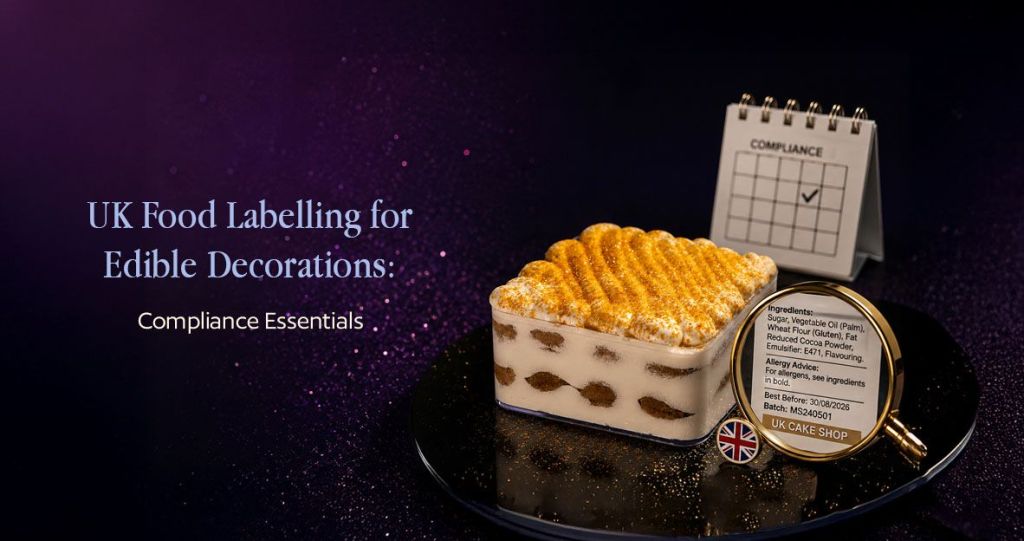
I nearly bought edible glitter for my daughter’s birthday cake last month before checking the label. Good reviews, nice photos, no ingredient list anywhere, just “non-toxic” on the packaging, which tells you it won’t poison you, not that it’s food.
I closed the tab. That gap between “safe to touch” and “safe to eat” is what UK food labelling for edible decorations exists to close, and it matters more than most sellers of cake decorations seem to realise. Going through the actual regulations, plenty of sellers either don’t know the rules or hope nobody checks.
Table of Contents
Why Labelling Compliance Matters for Edible Decorations
Correct labelling isn’t box-ticking. It’s legal protection, for the business and for the people eating the cake. Picture a bakery in north London that had bought glitter in bulk from the same cheap supplier for three years, until a customer asked about allergens. There was no label to check, and the supplier couldn’t produce an English ingredient list either. Three years of sales had happened without anyone knowing what was actually in the product. The Food Standards Agency doesn’t treat that as innocent; not knowing what’s in something you’re selling is the absence of due diligence, not a defence.Get the label right and customers trust the ingredient list and allergen warnings, the business is legally covered if something goes wrong, and in a market full of vague-labelled imported glitter, a properly labelled product signals professionalism first.
UK Food Labelling Law: What Every Label Must Show
For pre-packed edible glitter, most of what’s sold, the Food Standards Agency requires specific information as a legal minimum.
The product name has to describe what it is: “edible glitter,” not “sparkle dust.” A full ingredients list in order of weight. The net weight or volume. The manufacturer or distributor’s name and address, so someone is accountable. A best before date, plus storage conditions where relevant.
The label also has to declare the 14 major allergens if present, in English, not French with English as an afterthought. Food additives need listing by name or E-number. Most budget glitter from overseas sellers skips this, offering a nice photo and a vague “safe” claim instead.
Allergen Labelling: The 14 Major Allergens
This is the section that can genuinely protect someone.
UK law requires all 14 major allergens to be flagged if present: cereals containing gluten, crustaceans, eggs, fish, peanuts, tree nuts, milk, celery, mustard, sesame, sulphites, molluscs, lupin, and sulphur dioxide. If made in a facility processing any of these, that needs declaring too; “may contain traces of” carries as much weight as “contains.”
Maltodextrin-based glitters, including Magic Sparkles, typically don’t contain the major allergens themselves, but cross-contamination can happen anywhere along a supply chain, which is why the label matters regardless of recipe. Reading edible glitter labels for allergen information should never feel like guesswork, especially for a parent whose child has a severe allergy.
E-Numbers and Additive Warning Labels
If glitter contains additives or artificial colourings, the label has to say so by name or E-number; not optional depending on the ingredient.
E171, titanium dioxide, was banned in the EU in 2022 over genotoxicity concerns, and the UK looks likely to follow, so competitor glitters are being reformulated now. Where artificial colourings are used, UK law requires “may have an adverse effect on activity and attention in children,” a strong claim that exists because the effect is documented.
Magic Sparkles uses natural plant-based colourings only, with no synthetic additives and no E171, a manufacturing decision from the start rather than a reaction to changing rules.
Pre-Packed vs Loose Decorations: What Changes
Pre-packed glitter in a sealed pot needs the full label: ingredients, allergens, E-numbers, manufacturer details, best before date, all of it.
Loose glitter, sold by weight from a bulk bin, works differently. No printed label is required on an individual portion, but the retailer still has to hold full documentation and provide allergen information on request; responsibility shifts from packaging to seller.
Most online suppliers sell pre-packed, easier to verify before ordering.
What to Check When Buying from a Supplier
A quick checklist before ordering: full ingredients list in English? Allergens declared, or confirmed free from all 14? A best before date? Manufacturer named with a UK or EU address? Additives or E-numbers listed, with colourings flagged? This matters as much for a Christmas cake order as a birthday cake in June, and it’s worth double-checking before Bonfire Night, when reds and golds move fastest and a rushed order is when labels get skipped. Running established brands through this checklist turns up more gaps than expected; good marketing doesn’t guarantee a compliant label, only the label does.
How Magic Sparkles Meets UK Labelling Standards
Magic Sparkles carries a full English ingredient list: maltodextrin and natural plant-based colourings, nothing else. Products are certified free from the 14 major allergens, made in a SALSA-approved facility in Nuneaton, Warwickshire, and carry Vegan Society, Halal Monitoring Committee, and Manchester Beis Din kosher certification on the label. For bakers sourcing for clients with dietary or religious needs, understanding halal and kosher certified glitters and their documentation is easy when a supplier puts it on the label rather than leaving it to be asked about.
Conclusion
UK food labelling for edible decorations isn’t red tape. It’s the baseline.
Buying glitter with no ingredient list is a bet. Selling a cake with undeclared allergens is a risk. Working with a supplier who can’t say what’s in their product is a gamble, whether it’s a Christmas cake order or a Bonfire Night batch.
Professional bakers, the kind exhibiting at Cake International, already know where to buy fully compliant edible glitter, and treat the higher cost as cheap insurance.
Before your next order, pull up the label. Check the ingredient list, allergen declaration, manufacturer’s address, and best before date. If any are missing, ask the supplier, or find one who doesn’t make you ask.
Frequently Asked Questions
What must be included on a UK food label for edible decorations?
Product name, full ingredients list by weight, net quantity, manufacturer or distributor name and address, best before date, allergen declarations, any additives or E-numbers, storage conditions, and a statement if colourings are artificial.
Which 14 allergens must be declared on UK food labels?
Cereals containing gluten, crustaceans, eggs, fish, peanuts, tree nuts, milk, celery, mustard, sesame, sulphites, molluscs, lupin, and sulphur dioxide. If present, or made in a facility processing them, they must be declared.
Do edible glitter products need E-number labelling?
Only if the product contains additives or artificial colourings, listed by name or E-number. Products with natural colourings alone have none to declare.
What’s the labelling difference between pre-packed and loose decorations?
Pre-packed glitter needs a full printed label with all required information. Loose glitter must have documentation available, but the customer may not get a printed label; the retailer must provide allergen information on request.
How can a bakery check a supplier’s labelling is UK-compliant?
Ask for the full label before ordering. Verify it includes an ingredients list, allergen declarations, manufacturer details, a best before date, and any E-number or additive warnings. If evasive about ingredients, find a different supplier.