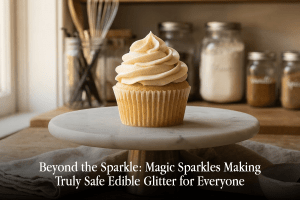
You have spent hours on a cake. The buttercream is smooth, the glitter is perfect, the fondant details are exactly right. Then the weather turns warm and your creation starts slowly losing the battle. If you are trying to figure out how to keep cake decorations from melting, you are dealing with one of the most frustrating challenges in baking. And it happens to professionals just as often as it happens to home bakers.
The good news is that this is largely a question of understanding what causes the problem in the first place, and then making intentional choices about your ingredients, your environment, and your storage approach. This guide covers all of it, practically and clearly.
Why Cake Decorations Melt In Warm Weather
Heat and moisture are the two primary enemies of a decorated cake. Understanding how each one works helps you counter them more effectively.
Buttercream is fat-based. The moment temperatures rise above around 20 to 22 degrees Celsius, the butter in your buttercream begins to soften. At 25 degrees and above, it can lose structural integrity entirely and start to slide or collapse. This is especially problematic for piped details, flowers, and any element that relies on the buttercream holding its shape.
Fondant behaves differently. It is primarily sugar and gelatin, and its enemy is moisture rather than heat alone. In a humid environment, fondant absorbs water from the air and becomes sticky, soft, and prone to collapsing or developing an unpleasant sweating appearance. Cake humidity problems are particularly common in summer months or in kitchens where cooking is happening simultaneously.
Edible glitter, on the other hand, behaves remarkably well in warm conditions when it is made from the right ingredients. Magic Sparkles products are made from maltodextrin, a carbohydrate that does not melt or run like sugar-based products. Their prismatic shimmer stays intact even in warmer environments, which is one of the reasons they are increasingly popular with professional bakers working in outdoor settings or warm venues.
How to Keep Cake Decorations From Melting: The Science
To prevent cake decorations from melting, you need to understand what each material responds to and address those sensitivities directly.
Buttercream softens because the fat content reaches its melting point. Butter has a relatively low slip point, typically between 28 and 33 degrees Celsius depending on its water activity and fat composition — which is why even modest ambient warmth causes visible softening. The solution is either to use a recipe with a higher melting point fat, to adjust the ratio of fat to sugar, or to stabilise the buttercream with meringue or additional structure.
Fondant collapses because it absorbs moisture. The solution is to minimise the fondant’s exposure to humid air and to ensure the cake beneath it is properly chilled and dry before the fondant is applied.
Sugar decorations and edible flowers dissolve because sugar is hygroscopic. It pulls moisture from the air and dissolves itself in the process. The solution is to minimise exposure time and to avoid refrigerating sugar decorations if condensation is a risk.
Every material has a weakness. Knowing yours means you can address the problem before it becomes an emergency.
Buttercream Melting Solutions That Work
Buttercream melting solution starts at the recipe stage. Here are the most effective approaches.
Switch to Swiss or Italian meringue buttercream: These buttercreams have a higher ratio of cooked egg white to butter, which gives them better structural stability at room temperature than a standard American buttercream. They are also silkier and less sweet, which many people prefer.
Add a small amount of vegetable shortening: Replacing 20 to 30 percent of the butter with high-ratio shortening raises the melting point of your buttercream. The result is a frosting that holds its shape more reliably in warm conditions without sacrificing too much flavour.
Chill your layers: After crumb coating your cake, refrigerate it for at least 30 minutes before applying the final buttercream layer. A cold base helps the outer layer hold its shape longer when the cake is at room temperature.
Avoid over-beating: Buttercream that has been over-whipped incorporates too much air and becomes less stable. Beat until just combined and smooth for the most heat-resilient result.
In commercial bakery operations, a standard quality-control protocol for warm-weather deliveries involves chilling finished buttercream cakes for a minimum of two hours before dispatch. The cold thermal mass slows the rate at which the outer surface reaches ambient temperature, buying several hours of decoration stability even in challenging conditions.
Fondant Melting Prevention Techniques
Fondant melting prevention is primarily about moisture management rather than temperature control. These techniques make a measurable difference.
Apply fondant to a chilled, dry cake: A warm or wet cake surface under fondant creates steam that causes the fondant to sweat and soften from the inside out. Always chill your cake with a crumb coat of buttercream, let it dry slightly, and then apply your fondant.
Use a thin layer of shortening rather than water: Many bakers brush water or alcohol onto their buttercream to help fondant adhere. Shortening is a better option in warm or humid conditions because it does not add moisture to the surface.
Avoid refrigerating fondant-covered cakes if possible: When a fondant cake comes out of the fridge, condensation forms on the surface as it warms up. This moisture causes the fondant to go sticky and shiny. If refrigeration is necessary, bring the cake to room temperature in a room with air conditioning to slow condensation.
Use tylose powder in your fondant: Adding a small amount of tylose (carboxymethyl cellulose) to your fondant gives it a firmer, more elastic texture that resists humidity better than standard fondant.
Managing Cake Decoration In Hot Weather
Cake decoration in hot weather requires planning beyond just the recipe itself. Your workflow and environment matter as much as your ingredients.
Work in the coolest part of the day. If you are decorating in summer, early morning is almost always preferable to the afternoon. Kitchen temperatures can rise significantly by midday, especially when the oven has been in use.
Keep your workspace cool. Air conditioning is ideal, but if it is not available, a fan directed at the work surface and a bowl of iced water nearby can help manage ambient temperature during decoration.
Decorate as close to the event as possible. The longer a cake sits decorated at room temperature, the more opportunities heat and humidity have to cause problems. Where possible, complete final decorations the morning of the event rather than the day before.
For outdoor events specifically, identify a shaded area for the cake display and arrange for it to be brought out as late as practically possible before serving. Cake decoration in hot weather is manageable, but it rewards careful planning.
Handling Cake Humidity Problems Effectively
Cake humidity problems are often more damaging than heat alone, and they can occur even in mild temperatures if the air is particularly damp.
A dehumidifier in your work and storage space makes a significant difference if you bake regularly in a humid climate or during the summer months. This single investment reduces fondant sweating, prevents sugar decorations from dissolving, and keeps buttercream firmer longer.
Silica gel sachets placed in the cake box during transport absorb ambient moisture and protect the cake during the journey from your kitchen to the venue. Use food-safe silica sachets to ensure there is no contamination risk.
Avoid stacking decorated cakes or boxing them too tightly. When air cannot circulate around a boxed cake, humidity from the cake itself has nowhere to go and collects on the surface. A box that is slightly larger than the cake allows for airflow and reduces moisture buildup.
Bakery Storage Tips For Decorated Cakes
These bakery storage tips apply whether you are a professional running a cake business or a home baker preparing for a weekend event.
Dedicated refrigeration: If possible, store decorated cakes in a refrigerator that is not being opened and closed frequently for other food preparation. Every time a refrigerator door opens, the internal temperature and humidity fluctuate, and that fluctuation affects your cake.
Use a cake box, not cling film: Wrapping a decorated cake in cling film traps moisture against the surface and can cause condensation damage. A properly sized cardboard cake box allows the surface to breathe while still providing protection.
Keep cakes away from strong-smelling foods: Cakes absorb odours from their surroundings. A refrigerator that also stores fish or strong cheese is not ideal storage for a delicately flavoured cake.
Label your storage time: Decorated cakes should generally be consumed within two to three days of decorating for the best quality. Labeling when the cake was finished helps you manage this without guessing.
How To Store Decorated Cakes Before Events
Knowing how to store decorated cakes in the period between completion and serving makes a meaningful difference to the final result your guests experience.
For buttercream cakes, refrigeration is your best option. Store in a cake box to prevent the surface from absorbing fridge odours or condensation from other items. Remove from the refrigerator one to two hours before serving so the cake comes to room temperature gradually and the buttercream softens naturally to a pleasant eating texture.
For fondant cakes, room temperature storage in a cool, dry environment is preferable to refrigeration if the cake will be consumed within 24 hours. If it needs to be stored longer, refrigerate with care and allow adequate time to come back to room temperature before display.
For cakes decorated with edible glitter, there is good news. Truly edible glitter made from maltodextrin, like Magic Sparkles, is stable across both temperature and humidity ranges that would cause other decorations to deteriorate. It does not run, melt, or dissolve from the cake surface the way sugar-based decorations can. This makes it one of the most reliable decoration elements you can choose if you know your cake will face warm or humid conditions.
Ingredients That Improve Heat Stability
Certain ingredients improve heat stability significantly when incorporated at the recipe stage.
High-ratio shortening in buttercream raises the fat melting point and produces a more stable frosting in warm conditions.
Tylose powder added to fondant increases elasticity and humidity resistance considerably.
Cream cheese added to buttercream at a small ratio increases density and helps the frosting hold its shape longer, though it also reduces the shelf life slightly.
Maltodextrin-based glitters like Magic Sparkles are inherently more heat and humidity stable than alternatives. If you are concerned about decoration integrity in warm environments, choosing edible glitter as a key decorative element is a genuinely practical decision, not just an aesthetic one.
Conclusion
Learning how to keep cake decorations from melting is not about finding one magic solution. It is about understanding your materials, adapting your recipes, managing your environment, and planning your workflow so that everything works together. Every technique in this guide addresses a specific vulnerability in a specific material.
The bakers who handle warm-weather events most successfully are the ones who have thought through the problem before the event day arrives, not during it. Preparation, good ingredients, and proper storage are the three things that make the difference between a cake that arrives looking exactly as intended and one that has spent the journey becoming something else entirely.
Plan, choose stable ingredients, and store your cakes with care. That is how it is done. For the decoration layer itself, Magic Sparkles is the performance-driven choice—a maltodextrin-based edible glitter engineered for heat and humidity stability and trusted by professional bakers who cannot afford to compromise on the finish.
Choose a heat and humidity-stable decoration from the start—find out where to buy edible glitter built for real baking conditions.
FAQ
Why do cake decorations melt in warm weather?
Most cake decorations are fat-based or sugar-based, and both are sensitive to heat and humidity. Buttercream softens when temperatures exceed around 20 to 22 degrees Celsius because the fat content begins to melt. Fondant absorbs moisture from warm, humid air and becomes sticky and unstable. Understanding which material is reacting to which condition helps you target the right solution.
Can edible glitter melt off a cake in heat and humidity?
Truly edible glitter made from maltodextrin, like Magic Sparkles, is significantly more stable in heat and humidity than sugar-based decorations. It does not run, dissolve, or slide off a cake surface the way some other decorations can. This makes it a particularly reliable choice for cakes destined for warm or outdoor environments.
How do you protect buttercream and fondant from melting?
For buttercream, switch to Swiss or Italian meringue buttercream, add a small proportion of high-ratio shortening, and always chill your cake before delivery. For fondant, apply it over a chilled, dry crumb coat, avoid refrigerating if possible, and add tylose powder for improved humidity resistance.
What storage tips can prevent cake decorations from sagging?
Store decorated cakes in a cake box rather than cling film to allow airflow. Use dedicated refrigeration that is not opened frequently. Keep cakes away from strong-smelling foods. For fondant cakes, prefer cool, dry room temperature storage over refrigeration where the timeline allows.
Are there heat-resistant edible glitters for warm conditions?
Yes. Edible glitters made from maltodextrin are inherently more heat-stable than alternatives. Magic Sparkles products are manufactured from food-grade maltodextrin with natural plant-based colorings and no synthetic additives, giving them better performance in warm and humid conditions compared to sugar-based or plastic-based alternatives.